
An ingredient can appear simple until it reaches a production line. Date paste for food manufacturing can influence sweetness, texture, binding, color and handling at the same time. Consequently, it deserves the same technical attention as any other functional food ingredient.
For food brands, industrial date paste creates compelling possibilities across bakery, snacks, fillings and confectionery. However, successful product development depends on more than adding dates to an existing recipe. Moisture, consistency, particle size, flavor and processing behavior can all change the final result.
The smartest question is therefore not simply, “Can we use date paste?” Instead, manufacturers should ask, “What must this Saudi date ingredient do in our finished product?”
Date paste for food manufacturing starts with function
Every formulation gives date paste a different job. In a soft snack, the date-based ingredient may help bind nuts, seeds or cereals. Inside a biscuit, it may need to remain smooth after baking. In confectionery, the same industrial date paste may need to hold its shape beneath a coating.
These applications sound similar, yet they create very different production requirements. A paste designed for manual preparation may become difficult to pump, portion or deposit on an automated food manufacturing line.
Before requesting a sample, product developers should therefore define the expected function:
- Provide a consistent date flavor
- Support binding or product structure
- Remain soft after heating or baking
- Move cleanly through production equipment
- Maintain an agreed color and texture
- Work within the target packaging and shelf-life system
This functional brief gives suppliers a clearer basis for recommending the appropriate date variety, blend, texture and packaging format.
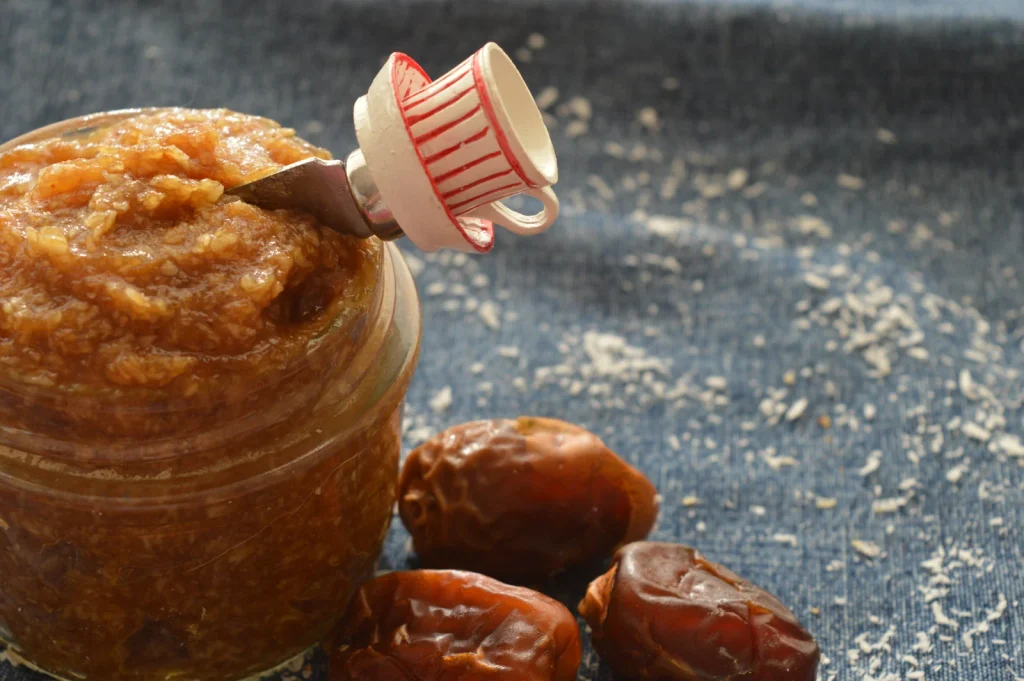
One date ingredient can serve several product ideas
Date paste for food manufacturing can support several product categories without making them identical. Bakery producers may use the ingredient in fillings, layered pastries or biscuits. Snack manufacturers can explore date paste in bars, bites and cereal-based products. Meanwhile, confectionery teams may test it in centers, coated pieces or modern interpretations of familiar flavors.
Nevertheless, date paste should not become a shortcut for an unsupported nutrition claim. A date-based ingredient may contribute flavor, sweetness, body or texture, depending on the recipe. However, the finished product’s composition and regulatory status determine which claims a brand may legally communicate.
This distinction protects both the manufacturer and the consumer. Strong product development begins with the ingredient’s real technical role, not with an attractive claim added after formulation.
Industrial date paste must perform beyond the sample
A sample can have an appealing flavor and appearance while still failing during production. Date paste for food manufacturing must also withstand mixing, heating, cooling, pumping, depositing and storage under realistic factory conditions.
For example, industrial date paste may feel manageable at room temperature but become difficult to portion in a cooler production environment. A smooth sample may also react differently when combined with fats, flour, chocolate, nuts or other ingredients.
Manufacturers should therefore test the date ingredient in the intended recipe and on the intended equipment. A useful trial records temperature, processing time, equipment settings, yield, product loss and the final sensory result.
The Codex Regional Standard for Date Paste establishes definitions and quality characteristics for the product. Even so, compliance with a standard does not replace an application-specific production trial.
Saudi date ingredients offer room for innovation
Saudi Arabia provides a strong environment for exploring date paste for food manufacturing and other value-added date ingredients. The National Center for Palms and Dates reported that Saudi date production exceeded 1.9 million tonnes in 2024, while exports reached 133 countries.
More importantly, the sector extends beyond whole dates. Saudi producers are developing date paste, syrup, powder, pieces, fillings and other formats that can respond to different industrial applications.
The National Center for Palms and Dates reported that Saudi date exports reached SAR 1.695 billion in 2024. This expanding international presence creates opportunities for food businesses seeking distinctive Saudi ingredients, provided that origin, specification and production consistency remain verifiable.
For manufacturers, the opportunity is not merely to place dates on the ingredient list. It is to develop products in which Saudi date ingredients have a clear sensory, technical and commercial purpose.
Consistency creates the real manufacturing advantage
An impressive sample has little value if the next shipment behaves differently. Date paste for food manufacturing becomes commercially viable when the supplier can maintain an agreed specification across batches.
Food manufacturers should define the expected composition, moisture, texture, color, flavor, particle size, packaging and storage conditions. They should also understand how the producer manages traceability, foreign-material controls, batch testing and changes in raw materials.
These details may appear less exciting than the finished product. Yet they protect production schedules, product quality and customer confidence. Reliable industrial date paste must work repeatedly, not only during the first presentation.
A written technical brief also improves commercial discussions. It allows the manufacturer and supplier to compare the same requirements, evaluate representative samples and address potential production risks before confirming larger volumes.
From a promising ingredient to a scalable product
Date paste for food manufacturing offers far more than a familiar flavor. Used thoughtfully, it can become part of a differentiated bakery, snack or confectionery concept. Used without a precise brief, it may create avoidable challenges on the production line.
The strongest projects connect product creativity with technical discipline. They begin with the desired consumer experience, translate that idea into measurable requirements and test the Saudi date ingredient under real manufacturing conditions.
PEAK Food Division is developing an export offer around Saudi dates and value-added date products. If your business is evaluating date paste for an upcoming food application, contact PEAK Ventures to share your product brief, target market and sourcing requirements.